Using Barkat without astrology or tarot
In short
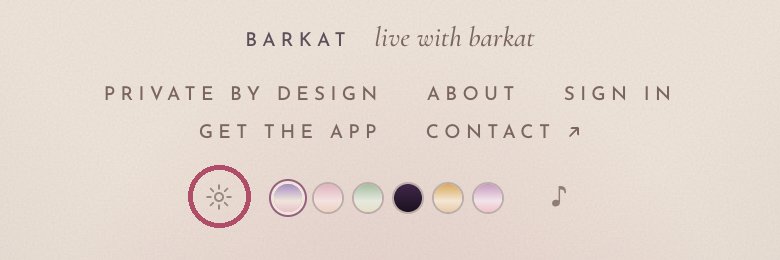
You can use Barkat as a plain cycle tracker. Tap the small sun-shaped gear at the bottom of any page, left of the wallpaper dots, and turn off "Tarot cards," "Astrology," or both. The Now tab then shows only the date, the moon phase, and your cycle card, and every cycle tracking feature works the same as before.
Turning them off deletes nothing, and you can turn them back on any time. Leaving them on doesn't mean you believe in them. Psychologists describe a trait called openness to experience, one of the Big Five, and enjoying tarot or astrology as a prompt for reflection fits that trait more than it fits any belief. Plenty of sharp, thoughtful people score low on openness and have no use for either, and that's fine.
How to turn off astrology and tarot in Barkat
Every Barkat page has a small gear at the bottom, drawn like a little sun, just to the left of the wallpaper dots. Tap it and a sheet titled "Show" opens with two switches. "Tarot cards" controls the card of the day, today's quest, and play the deck. "Astrology" controls the lunar day, the moon's star (its nakshatra), and the birth chart. Turn off one or both.
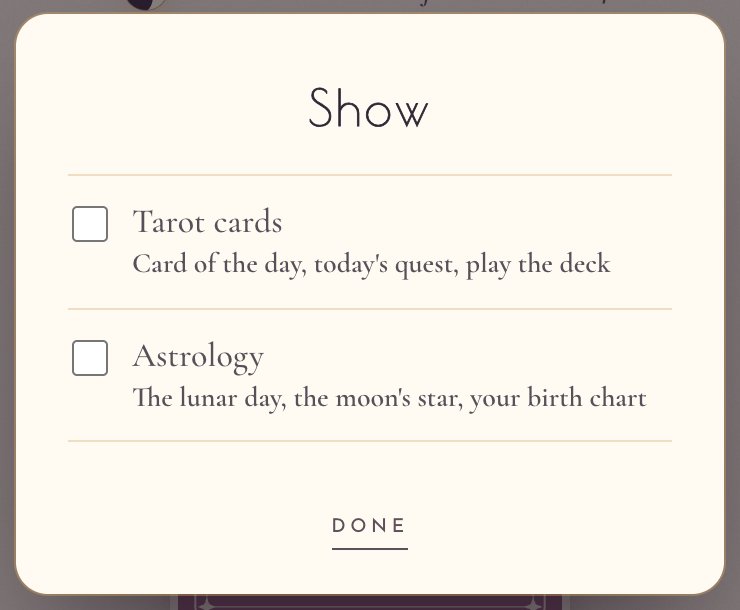
Nothing is deleted, and you can switch them back on whenever you like. If you use sync, your choice carries over to your other device.
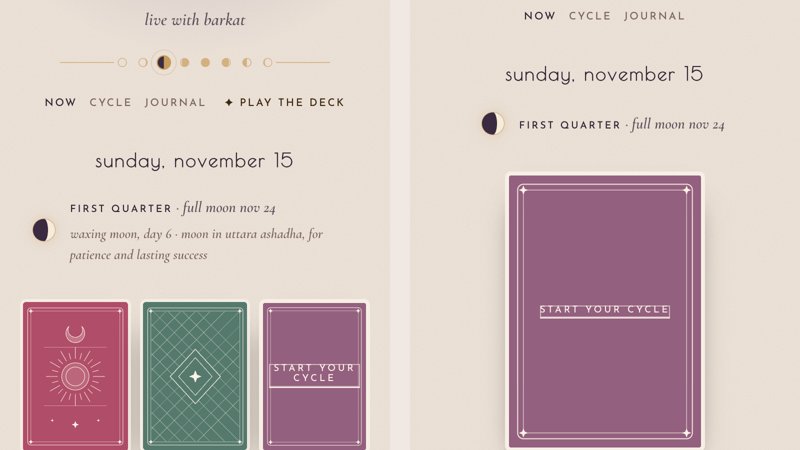
With both switches off, the Now tab shows only the date, the moon phase, and your cycle card. With tarot off, the "play the deck" tab disappears from the tabs. If you use sync, your choice carries over to your other device, so you only have to set it once.
Nothing is deleted when you switch something off. Old card draws, quests, and your birth chart details stay saved on your phone. Flip the switch back on and they're there again.
There's a second way to turn astrology off, for people who opened their birth chart and decided it isn't for them. At the end of the birth chart pane there's a quiet "turn off astrology" button. It opens the same settings sheet.
Why the moon phase stays
The moon drawing on the Now tab stays even with astrology off, because the moon's phase is astronomy. It's the share of the moon lit by the sun as seen from Earth tonight, the same thing a weather app or a tide table shows. Some people like it as a monthly rhythm for planning, and the moon phase planner guide covers that. The lunar day and the nakshatra come from Vedic astrology, so those go away with the switch.
What still works with both turned off
All of the cycle tracking works the same with tarot and astrology off. That includes:
- The month calendar with your period, fertile days, and ovulation estimate.
- Logging bleeding on any day, and adding word notes like "tired," "calm," or "focused."
- The optional signs: waking temperature, resting heart rate, and cervical fluid, with the temperature chart. See the basal body temperature guide for how to read it.
- Trends, which shows which words come up in each part of your cycle once you have enough days logged.
- The journal: intentions, blessings, your word of the year and month, the letter to your future self, and the book.
The privacy setup doesn't change either. There's no account, your data stays on your phone, and sync, if you turn it on, is locked with your own six-word phrase. The privacy page has the details. If you're comparing Barkat with other private trackers, the period tracker comparison lists the options, including ones that never had tarot or astrology to begin with.
Barkat isn't birth control and isn't medical advice, with any setting.
You don't have to believe in anything to use Barkat
This page takes no side on whether tarot or astrology works. The point of Barkat is to help you get to know your cycle and yourself, and you can do all of that with the switches off. The calendar, your notes, and trends over a few months will show you your own patterns, like which days you tend to feel tired or sharp, and when your period usually comes. The cycle phases guide and the guide to knowing yourself are written for anyone, with no cards or stars needed.
If you leave the cards and the astrology on, that doesn't mean you believe a card can predict your day or that the planets set your personality. Many people use a daily card the way they'd use a journaling prompt. It gives them a word to think about for a minute. Others like the birth chart because the math behind it is old and interesting, and the Vedic astrology calculations page explains how it's worked out. The how tarot works page is honest about what tarot can and can't do.
Research hasn't found that birth signs shape personality. A 2020 study of 173,709 adults in China found no link between any of the 12 sun signs and any Big Five trait. Liking a reflection prompt is a different question from whether it's true, and psychologists have a name for the trait behind enjoying that kind of thing.
Openness to experience and the Big Five personality traits
The Big Five, also called the five-factor model, is the most widely used way psychologists describe personality. It grew out of a simple idea called the lexical hypothesis: the traits that matter most to people show up as words in everyday language. Researchers sorted thousands of describing words with statistics over several decades and kept finding five broad groups. Lewis Goldberg named them the Big Five in 1981.
The five traits are:
- Openness to experience: interest in new ideas, art, imagination, feelings, and variety. People low in it tend to be practical and prefer the familiar.
- Conscientiousness: being organized, dependable, and careful about plans and promises.
- Extraversion: getting energy from people and activity. Introverts need more quiet time and aren't necessarily shy.
- Agreeableness: kindness, trust, and wanting to get along.
- Neuroticism: how strongly you react to stress and bad feelings. Its opposite is emotional stability.
Each trait is a scale, and most people land somewhere in the middle. A score describes a tendency, and none of the five has a right end to be on. If you want to see your own scores, the International Personality Item Pool publishes free, public domain Big Five questionnaires that researchers use.
Which part of openness fits tarot and astrology
The NEO-PI-R, a long Big Five test written by Paul Costa and Robert McCrae, splits openness into six facets:
| Facet | What it measures |
|---|---|
| Fantasy | A rich imagination and an active inner world |
| Aesthetics | Caring about art and beauty |
| Feelings | Paying attention to your own emotions |
| Actions | Wanting to try new things in daily life |
| Ideas | Intellectual curiosity |
| Values | Being willing to rethink your values and question authority |
Fantasy fits enjoying tarot and astrology best. It describes people who like symbols, stories, and imagined possibilities, and studies have found that people who believe in the paranormal tend to score higher on fantasy proneness. You can score high on fantasy and treat a card as nothing more than a picture that starts a thought.
Ideas fits a different kind of interest. Someone curious about how a centuries-old system tracks the moon across 27 stars may enjoy it the way they'd enjoy a puzzle, with no belief at all. Feelings can play a part too, if you use the daily card mostly to notice how you feel.
Openness shows up among skeptics as well. Psychologists have noted that atheists and people who believe in the occult both tend to score high on openness. Skeptics usually lean toward the intellectual side (Ideas, Values), and believers in the paranormal lean toward the imaginative side (Fantasy). The trait describes interest in new and unusual things, and people point that interest in different directions.
Personality can shift over a lifetime
Big Five traits are fairly stable, but they do move. In 2006, Brent Roberts, Kate Walton, and Wolfgang Viechtbauer pooled 92 samples from long-term studies that measured the same people over years. Most people became more conscientious, more emotionally stable, and more socially confident as they got older, especially in their 20s and 30s. Openness rose in the teens and early 20s, stayed about level through midlife, and dipped in older age.
People can also change a trait on purpose. Nathan Hudson and Chris Fraley ran two 16-week studies with college students, published in 2015. Students who wanted to change a trait tended to move in the direction they chose, and coaching them to make specific if-then plans ("if I'm in situation X, then I'll do Y") helped. The changes were small, though they were real. A 2017 review led by Roberts looked at 207 studies of therapy and other interventions and found measurable trait change over about 24 weeks, mostly in emotional stability, and it lasted in the studies that followed people afterward.
So if you'd like to be more open to new things, small, specific steps can help. You also don't need to change anything. Wanting to stay as you are is a fine choice.
Low openness says nothing bad about you
Being low in openness is a description, the same as being introverted. People low in openness often like routine, prefer proven methods, and care about what's practical. Those are useful strengths in plenty of jobs and families.
To be accurate about intelligence: openness does have a modest positive link with measured intelligence. A 2023 analysis by Kevin Stanek and Deniz Ones, drawing on data from millions of people, put the correlation between overall openness and general mental ability at about 0.26. Most of that comes from the intellectual facets. The Ideas facet came in around 0.40, while Fantasy (about 0.08) and Aesthetics (about 0.06) had almost no link. A correlation that size leaves enormous overlap, and plenty of sharp, thoughtful people score low on openness. It also means enjoying tarot or astrology tells you very little about how smart someone is, in either direction.
If the cards and stars aren't for you, switch them off and use Barkat for your cycle. If they are, leave them on. Either way is fine, and you can change your mind whenever you like.
What's free and what Premium adds
Cycle tracking in Barkat is free, with tarot and astrology on or off. Premium is free for everyone through 2026, and anyone who starts using Barkat before 2027 keeps it free for good. The table below shows what's in each.
| Barkat | Free, for good | Premium |
|---|---|---|
| Cycle calendar with period, fertile and ovulation estimates | Yes | Yes |
| Log bleeding, word notes, temperature, resting heart rate and cervical fluid | Yes | Yes |
| Temperature chart, import from other apps, spreadsheet export, calendar link | Yes | Yes |
| Locked sync to a second device | Yes | Yes |
| Journal: intentions, blessings, letters to your future self | Yes | Yes |
| Moon phase, lunar day, card of the day, play the deck | Yes | Yes |
| Cycle history on the calendar | This month and the two before | All of it |
| Trends: the words that come up in each part of your cycle | No | Yes |
| Vedic birth chart and dashas | No | Yes |
| Extra wallpapers and card backs | No | Yes |
| Price | $0 | $9, paid once |
Premium is free for everyone through 2026. If you start using Barkat before January 1, 2027, Premium stays free for you for good. After that it costs $9 one time, with no subscription and nothing to renew. Older cycle days are never deleted on the free plan; they're kept on your phone and show again if you get Premium.
Barkat is free in your phone's browser, and an iPhone app is coming in 2027. Get an email when it's out.
Questions people ask
Is there a period tracker without astrology?
Yes. Many trackers never had astrology, and Barkat lets you turn it off. Tap the sun-shaped gear at the bottom of any Barkat page and turn off the Astrology switch. The lunar day, the moon's star, and the birth chart disappear, and all cycle tracking keeps working.
How do I turn off tarot in Barkat?
Tap the small sun-shaped gear at the bottom of any page, left of the wallpaper dots. In the sheet titled Show, turn off Tarot cards. The card of the day, today's quest, and the play the deck tab go away.
Does turning off astrology or tarot delete anything?
No. Your past cards, quests, and birth chart details stay saved on your phone. Turn the switch back on and they show up again.
Will my setting carry over to my other phone?
Yes, if you use sync. Your choice of what to show syncs to your other device.
Why does the moon phase still show with astrology off?
The moon phase is astronomy. It shows how much of the moon is lit tonight, the same as a weather app. The lunar day and nakshatra are part of Vedic astrology, so those are hidden.
Does cycle tracking work the same without tarot and astrology?
Yes. The calendar, period, fertile and ovulation estimates, bleeding and word notes, temperature chart, trends, and journal all work exactly the same.
Does using tarot or astrology mean I believe in it?
No. Many people use a daily card as a journaling prompt or find the math of a birth chart interesting. Enjoying that fits a personality trait psychologists call openness to experience, and it doesn't require belief.
What is openness to experience?
It's one of the Big Five personality traits. It describes interest in new ideas, imagination, art, feelings, and variety. People low in it tend to be practical and prefer the familiar.
Which openness facet goes with liking tarot or astrology?
Fantasy fits best. It measures a rich imagination and an active inner world, and people who believe in the paranormal tend to score higher on it. Ideas, which is intellectual curiosity, fits people who like astrology as an interesting system.
Can your personality change?
Yes, slowly. Long-term studies show most people become more conscientious and emotionally stable with age, and openness rises in the teens and early 20s and dips in older age. Studies also show people can make small changes to a trait on purpose.
Does low openness mean low intelligence?
No. Openness has a modest positive link with measured intelligence, about 0.26 in a 2023 analysis, mostly through the Ideas facet. That leaves a lot of overlap, and plenty of sharp, thoughtful people score low on openness.
Is Barkat birth control?
No. Barkat's fertile and ovulation days are estimates, and Barkat isn't birth control or medical advice.
Where to find help
- International Personality Item Pool Free, public domain Big Five questionnaires used by researchers.
- Cleveland Clinic, The Big Five personality traits A plain introduction to the five traits from a therapist.
- Wikipedia, Openness to experience Facets, research on intelligence, and links to the studies.
- Stanek and Ones, Meta-analytic relations between personality and cognitive ability, PNAS (2023) The largest study of how each trait and facet relates to intelligence.
- BPS Research Digest, You can change your personality at will A clear summary of the Hudson and Fraley studies.
- Psychology Today, Where skepticism and superstition meet How openness shows up in both skeptics and believers.
Related reading on Barkat
Sources
- Wikipedia, Big Five personality traits
- Wikipedia, Openness to experience
- Cleveland Clinic, The Big Five personality traits
- Roberts, Walton, and Viechtbauer, Patterns of mean-level change in personality traits across the life course, Psychological Bulletin (2006)
- Donnellan and Lucas, Age differences in the Big Five across the life span, Psychology and Aging (2008)
- Hudson and Fraley, Volitional personality trait change, Journal of Personality and Social Psychology (2015)
- BPS Research Digest, You can change your personality at will
- University of Illinois, Counseling, antidepressants change personality for the better (2017)
- Stanek and Ones, Meta-analytic relations between personality and cognitive ability, PNAS (2023)
- Psychology Today, Opening the mind: where skepticism and superstition meet
- International Personality Item Pool
- Psychology Today, The final word on astrology and personality (2022)